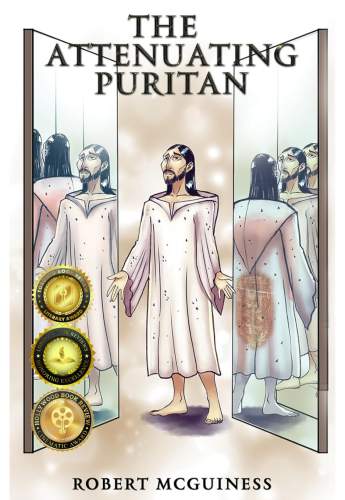
Robert McGuiness’s The Attenuating Puritan is a novel that resists easy classification. It moves with the restless energy of a pilgrimage, part confession, part satire, part ecological parable, and part spiritual fever dream. The book reads as though it has been lived rather than carefully plotted, and that lived quality becomes one of its defining strengths.
At its center is a narrator who calls himself “the Attenuating Puritan,” a figure both earnest and unreliable, sincere and self-mocking. Through his voice, McGuiness explores a world saturated with toxins, excess, belief systems, and contradictions. The novel travels through deserts, festivals, cities, and margins of society, but its real terrain is interior. Faith, guilt, responsibility, and hope are constantly tested against a modern landscape shaped by corporate power, environmental damage, and human fragility.
What makes this book compelling is not a conventional story arc, but the accumulation of moments and ideas. McGuiness writes in a style that feels improvisational and urgent. Sentences can be disturbing or unexpectedly tender. There is humor here, often dark, sometimes absurd, but it never feels detached. The laughter comes from recognition, not distance. The book asks readers to sit with discomfort rather than resolve it quickly.
The ecological themes are especially striking. Rather than preaching, the story embeds its concerns inside the narrator’s spiritual language and bodily experiences. Pollution, illness, and decay are not abstract concepts; they are felt, ingested, carried. This gives the book a physical weight that many issue-driven novels lack. At the same time, McGuiness avoids simple moral binaries. Institutions, movements, and even good intentions are treated with skepticism, including the narrator’s own.
There is also a strong sense of compassion running beneath the chaos. The people encountered along the way, many of them living on the edge of society, are not presented as symbols but as human beings. The book’s generosity lies in its refusal to flatten anyone, including its protagonist.
The Attenuating Puritan w is not a book for readers who want clear answers or a clean ending. It asks for patience and openness. In return, it offers a singular voice and a reading experience that lingers, unsettles, and provokes thought long after the final page. Readers interested in experimental fiction, spiritual inquiry, and ecological reflection will find this book well worth their attention, and quietly, insistently, worth recommending.
Purchase the Book Today on Amazon.
Author: Robert McGuiness
Page Count: 107
Rating: 5/5 Stars
Reviewer: Charlotte White